
Blog, Blog & Event, Guides & Tutorials
Electronics Manufacturing Cleaning Solution
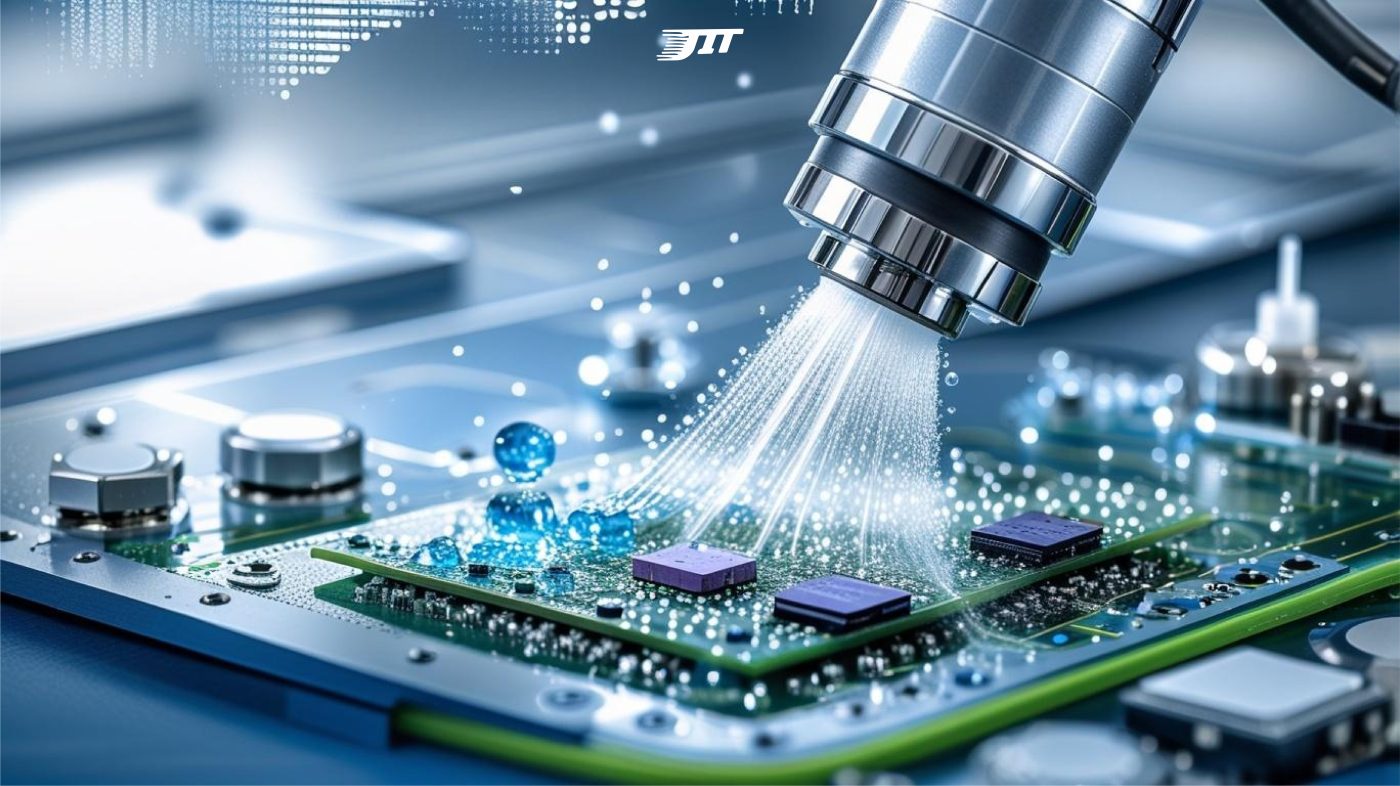
Electronics Manufacturing Cleaning Solution: Why Surface Cleanliness Determines Product Reliability
Cleaning solutions in electronics manufacturing are one of the most underestimated factors in determining the long-term reliability of PCB and PCBA assemblies. While factories invest heavily in SMT placement machines, reflow ovens, AOI, and X-ray inspection systems, the cleanliness of board surfaces between each of these steps is often left to chance.
The result? Products that pass final inspection but fail in the field — months or years later — due to corrosion, coating delamination, or electrical leakage caused by contamination that was never removed.
This guide explores the role of cleaning solutions across the full electronics manufacturing process, the contamination risks most factories overlook, the cleaning technologies available today, and how to select the right solution for your production line.
What Contaminates a PCB — And Why It Matters
Every PCB and PCBA assembly accumulates surface contamination throughout the production process. Most of it is invisible to the naked eye. All of it has consequences.
Common sources of surface contamination in electronics manufacturing include:
- Flux residue from wave soldering and reflow soldering — including ionic activators left by ‘no-clean’ flux
- Oils and greases transferred from mechanical handling, jigs, fixtures, and operator contact
- Industrial dust and ultrafine particles that settle into vias, under-component gaps, and BGA arrays
- Chemical residue from adhesives, underfill, and encapsulant materials
- Ionic contamination from process chemicals — invisible but electrically conductive
These contaminants rarely cause immediate failures. Instead, they degrade performance gradually under operating conditions — heat, humidity, vibration, and electrical load — until failure becomes inevitable.
Common field failure modes linked to poor surface cleanliness include:
- Electrochemical migration and conductor corrosion along PCB traces
- Reduced Surface Insulation Resistance (SIR), leading to leakage current and intermittent faults
- Conformal coating delamination, blistering, or adhesion failure
- Elevated failure rates during thermal cycling and humidity testing
- Unexplained field failures that cannot be reproduced on the production floor
For high-reliability applications — Automotive Electronics, Medical Devices, Industrial Control, and Aerospace — surface cleanliness is a specification requirement, governed by IPC-610, IPC-7711/21, and J-STD standards. Factories supplying these industries must be able to verify and document their cleanliness process.
Where Cleaning Solutions Are Applied in the Electronics Manufacturing Process
A common misconception is that cleaning solutions in electronics manufacturing are only needed after soldering. In a well-designed production environment, cleaning is integrated at multiple critical stages:
1. Post-Solder Defluxing (Flux Removal)
The most critical cleaning stage in SMT production. Flux residues — particularly from no-clean formulations — contain organic acids and halide activators that become corrosive under high-humidity conditions. Defluxing removes these residues and brings boards into compliance with ionic cleanliness standards before further processing.
2. Pre-Coating and Pre-Underfill Surface Preparation
Before applying conformal coating, potting compound, or underfill, the PCB surface must be free of organic and ionic contamination. Any residue present will reduce coating adhesion, create micro-voids, and form moisture ingress pathways. Skipping pre-coating cleaning is one of the leading causes of conformal coating failure in the field.
3. Pre-Plasma Treatment Cleaning
Plasma surface activation is used to increase wettability and bonding strength on PCBs and substrates. However, plasma treatment is only effective on a contamination-free surface. Even a thin film of oil or organic residue significantly reduces plasma activation efficiency — making a pre-plasma cleaning step essential for consistent results.
4. Stencil, Jig, and Fixture Maintenance
Solder paste stencils accumulate paste and flux residue with every print cycle. Without regular cleaning, stencil apertures partially block, degrading print quality and increasing bridging defects. Jigs and fixtures that accumulate flux and solder balls become contamination sources themselves, recontaminating the boards they are meant to support.
5. Pre-Assembly Cleaning for Fine-Pitch and High-Density Components
BGA, QFN, flip-chip, and other fine-pitch component assemblies require precise, contamination-free bonding surfaces. Residues at the bonding interface affect solder joint integrity, void formation, and X-ray inspection accuracy. Pre-assembly cleaning in these applications is a process requirement, not an enhancement.
Cleaning Technologies Used in Modern Electronics Manufacturing
The selection of cleaning solutions for electronics manufacturing depends on the contamination type, component sensitivity, production volume, and cleanliness specification required. Key technologies include:
Flux Removers and Defluxing Chemicals
Specialized defluxing chemistries are formulated to target specific flux types — rosin-based, water-soluble, and no-clean. Correct chemistry selection is critical: an incompatible formulation may fail to remove the target residue or attack sensitive component markings and plastics. Modern flux removers are engineered to be low-VOC and RoHS-compliant while maintaining high cleaning efficacy.
Ultrasonic Cleaning Machines
Ultrasonic cleaning uses high-frequency acoustic cavitation to agitate and remove contaminants from complex geometries, blind vias, and under-component spaces that manual or spray cleaning cannot access. Ultrasonic systems are widely used for batch cleaning of assembled PCBs, connectors, precision mechanical parts, and electronic subassemblies.
Dry Ice Cleaning Systems
Dry ice cleaning (CO2 pellet blasting) is a non-contact, non-abrasive process that leaves zero secondary residue — the dry ice sublimates on impact, carrying away contaminants without moisture or chemical solvents. It is particularly effective for cleaning production molds, jigs, fixtures, and sensitive electronic assemblies without requiring disassembly or machine downtime.
CO2 Snow and Supercritical CO2 Cleaning
CO2-based cleaning systems dissolve and remove organic contaminants at a molecular level, making them suitable for the most demanding cleanliness specifications — optical components, medical assemblies, and aerospace electronics where solvent residue or water contamination are not acceptable.
Inline and Batch Automated Cleaning Systems
Inline cleaning machines integrate directly into the SMT production line for continuous, parameter-controlled washing immediately after soldering. Batch systems handle larger assemblies or mixed product types. Both approaches eliminate operator variability, reduce cycle time, and provide process documentation for quality audits and customer requirements.
The Cost of Insufficient Cleaning: A Business Perspective
The ROI argument for investing in proper cleaning solutions in electronics manufacturing becomes clear when the true cost of insufficient cleaning is calculated:
- Rework and repair labor for contamination-induced field failures
- Warranty claims and replacement costs for products that fail prematurely in the field
- Customer relationship damage and loss of repeat business from reliability issues
- Audit failures when global customers require evidence of IPC cleanliness compliance
- Scrapped assemblies when coating adhesion fails at final inspection
- Production downtime caused by stencil blockage and jig contamination buildup
In contrast, a well-implemented cleaning process reduces defect rates, extends equipment life, supports compliance with international quality standards, and strengthens your position in customer audits.
As Vietnamese electronics manufacturers increasingly supply global customers in automotive, medical, and industrial sectors, cleanliness certification and process documentation are becoming standard requirements in RFQ evaluations and annual audits. Factories that cannot demonstrate controlled cleanliness processes will find themselves at a growing competitive disadvantage.
How to Select the Right Cleaning Solution for Your Production Line
Choosing the correct cleaning approach requires evaluating several factors:
- Flux type used in your process (rosin, no-clean, water-soluble) — determines compatible defluxing chemistry
- Component sensitivity — some chemistries or mechanical cleaning methods are not suitable for fine-pitch or sensitive components
- Production volume and throughput requirements — batch vs. inline cleaning system selection
- Cleanliness specification required — IPC Class 2 vs. Class 3, customer-specific ionic cleanliness thresholds
- Environmental and regulatory requirements — VOC limits, wastewater treatment, RoHS compliance
- Integration requirements — standalone cleaning station vs. integration into existing SMT line layout
A technical assessment of your current process — contamination sources, failure modes, and cleanliness gaps — is the most reliable starting point for selecting and implementing the right solution.
JIT Asia: Comprehensive Cleaning Solutions for Electronics Manufacturing
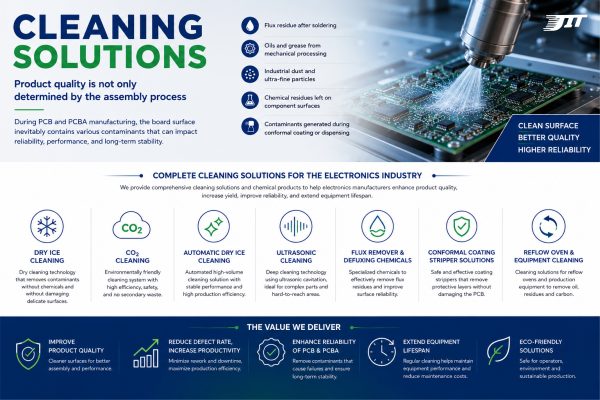
At JIT Asia, we supply and support a full range of cleaning solutions for electronics manufacturing — from defluxing chemicals and ultrasonic machines to dry ice cleaning systems and pre-plasma surface preparation solutions.
Our product and service portfolio includes:
- Flux Removers and Defluxing Chemicals — formulated for rosin, no-clean, and water-soluble flux systems
- Ultrasonic Cleaning Machines — for PCB, component, and precision part batch cleaning
- Dry Ice Cleaning Systems — non-contact, zero-residue cleaning for equipment and assemblies
- CO2 Cleaning Systems — for high-specification and contamination-sensitive applications
- Pre-Plasma and Pre-Coating Surface Preparation Cleaning
- Technical consultation — process assessment, chemistry selection, equipment sizing, and IPC compliance support
With experience supporting electronics factories across Vietnam and Southeast Asia, our technical team understands the specific contamination challenges of high-humidity manufacturing environments — and can help you design a cleaning process that meets both your quality requirements and your production economics.
Contact JIT Asia to request a technical consultation on cleaning solutions for your electronics manufacturing process.